Note: Due to limited wireless Internet access, this blog will be updated semi-frequently. Stay tuned for my subsequent "post boluses..." :-)

Monday, May 3, 2010

Day Fifteen and Sixteen: A Tale of Two Cities


One thing that really struck me during my Khmer New Year travels was the level of poverty surrounding the city of Siem Riep. Lining the road to Angkor Wat are village upon village of thatched-roof huts and barren rice fields. Everyone and everything--from adults and children to the cattle--looks dried out and emaciated. It's a strange juxtaposition amidst the striking majesty of the Angkor temple ruins. After all, who would ever think that such poverty could exist along side one of the seven greatest man-made wonders in the world?

Contrast this with some of the sights around town. I took the majority of Saturday to do a walking tour around town with my friends. We walked around the area, taking note of the lavishness of some of the area hotels and stores and observing the lively hustle and bustle of tourists and locals alike. But what was really striking were some of the pagodas. The city of Siem Riep has a population of roughly 150,000, and to it's credit, there are 13 major pagodas. These so called "wats" are both where monks reside and where the locals come for worship and other Buddhist ceremonies. While each varies slightly in its construction, they all have in common a "preah vihear" or "sacred sanctuary" that's absolutely extravagant. Here's a picture of one (Wat Bo):

Obviously my camera does not do any justice to how grand this building is. And things only get more intricate inside, with walls covered with elegant murals and handcrafted tapestries.
For me, at least, it's difficult to reconcile the wealth of these pagodas with the abject poverty of the people who live around here. Of course, many of the pagodas were constructed at another time. Together, they form the voice of the Siem Riep city that thrived before Cambodia got sucked up in the Vietnam War and before its abject destruction at the hands of the Khmer Rouge.
I was talking to B, the Brown ID fellow, the other day, and he mentioned that Siem Riep had changed dramatically since the last time he was here in 2002. With tourism booming, the city itself is definitely becoming a key source of national splendor. But the real story, I think, is much more complex than that, with corruption and governmental disorganization still the norm around here. So long as that's the case, I know I'll always be haunted by the duplicity of wealth and poverty that is Siem Riep.

Sunday, May 2, 2010

Day Fourteen: Holiday with a Bittersweet End


I went to work this morning, fully prepared to help M with his fever study database when news arrived that there had been a patient death sometime in the early dawn. V, a staff physician who had just gotten back from the U.S., came into the microbiology room with the report that a young child with acute gastroenteritis (whose parents I had spoken to a couple of days ago) had needlessly passed away due to medical error. Apparently the residents were too afraid to give the child much fluid due to his malnutrition, and the child started developing worsening diarrhea and an increasingly slow heartbeat. Eventually he was taken to the ER, and given pressors (drugs that make the heart beat), but for some reason, no the child still did not get adequate fluids during this entire time. "It's sad," said M, when he heard the news. "This child probably wouldn't have died if he was watched a little more carefully. Basically he died because it was Khmer New Years..."

And as much as I hate to admit it, M was right. Even though the hospital was still open during the holidays, it was run with as skeletal a staff as I've ever seen. With only a few residents managing the ER, ICU and the Inpatient ward all at once, it is in a way inevitable that something bad was going to happen.

For me, the fact that this happened to a patient whom I had examined just a couple of days before really hit home. I had spent the past two weeks floating around in the periphery, not saying much and writing random notes in charts that I assumed would never be read. But surely I could have been a better patient advocate? After all, M and B were there and had written a note for the residents to the effect that the child needed to be watched. Perhaps I should have stayed longer and reminded the resident to look for their note.

In any case, it was clear that M and B felt bad and even a little guilty too. What a way to dampen Khmer New Years.

But on a lighter note, I was able to get away in the late afternoon for a look at Bayon and Angkor Thom. Here's unfortunately the only view I was able to take before my batteries went dead:


True, it's not the sunset I was hoping to catch, but at least it was a bright ending when compared to the events of my day!

Day Thirteen: Khmer New Year Part Two

So, here's a picture of how my day started out:


After a rough night (yes, I'm still sick) and an early start at 4:30a.m., this view of the sunrise from the mighty depths of Angkor Wat was definitely worth the trouble.

Luckily I wasn't alone for this adventure. My new friend, A, who is a resident doctor from Australia, was my traveling buddy, and together we had a wonderful touristy morning.

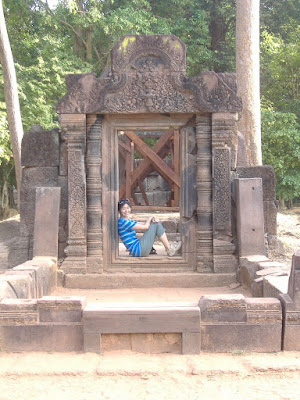
Following the sunrise at Angkor Wat, we took a tuk tuk (basically a small carriage hooked up to the back of a motorcycle) out to visit Banteay Srey--a fairly well-known temple that sits on the fringe of the Angkor temple complex. Its name in Khmer roughly translates to "Citadel of Women," and it's easy to see why. Most of the arches and doors are low-hanging and narrow, and the entire temple is decorated with carvings so intricate that it's commonly thought that none but a woman's hand could have done them.

Here's a picture of me in one of the narrow doorways:


And below is an example of all the gorgeous carvings on the walls. They are definitely the best preserved of any of the temples I've seen:


On the way back from Banteay Srey, A had the wonderful idea to stop at a local butterfly garden that was located on the road back to town. It was an incredible experience. The garden was part of a NGO striving to find eco-friendly ways of improving the livelihood of the poor villagers in the area. Apparently the founder had a big heart for butterflies, which were systematically being destroyed by the villagers' logging habits. Since then, the organization has used grant money to train the villagers to create and maintain a wonderful butterfly garden that both preserves local butterflies while providing a way to earn income from tourists. All I can say is that I wish I had a better camera so I could do justice to how beautiful the butterflies were.

This is me getting friendly with the catepillars:


And here's where they keep all the pupae, providing them a safe place to emerge from their cocoons and transform into butterflies:


Last but not least, here's the final product:


After the butterfly gardens, we went back to the city. Wish I could say I did something else productive after this, but I pretty much passed out when I returned back to my room and slept away the rest of the day.

Hopefully Day 3 of Khmer New Year brings something more exciting...

Day Twelve: Khmer New Year Part One


So as a background, I’ll say this: Cambodian people love to party! It seems like they try to take public holidays whenever the opportunity presents itself, and Khmer New Year is no exception. For three days (April 13-16), the entire city shuts down so people can visit with their families or pay their annual respects to the temples.
Of course, it goes without saying that the hospital never completely shuts down.

Originally, I, too, was planning to take time off. This plan soon changed when I learned that B, the ID fellow from Brown, was also planning to be at the hospital during this time to familiarize himself with the place. I agreed to tag along...partly to see if I could help out, but mostly to make sure I wasn’t missing anything.

My first day of holiday was botched by my getting yet another about of food poisoning the night before. Don’t ask how I managed to get two bouts of food-borne illness in the span of 12 days, but in any case, I was fairly incapacitated for most of the morning. I was brave enough to go to a local pagoda with Dr. C and the residents around noon—which, between the heat, my nausea, and my aching belly—was pretty much a set up for disaster. Luckily, I made it back to my room without public incident.

Whether I was dedicated or simply delirious from volume depletion, I forced myself to go back to the hospital for afternoon rounds. This was, of course, before learning that there are no official attending rounds during Khmer New Years. For better or worse, M and B decided to do their own teaching rounds, which were greeted with a fairly lukewarm response by the residents. It's becoming clear to me that they are used to a more "hands off" form of rounds, where there's not as much interaction or teaching from the attending. So it was rather amusing to me to see the residents squrim and try to look attentive as M and B attempted to dole out clinical pearls. Not that I was in particularly top form myself, with my visible bouts of abdominal pain and trips to the bathroom.

Thanks to the hospital's skeletal crew, I was able to help out more than usual. In fact, I was able to do my first semi-H&P in Khmer, since neither M or B speak much of the language. Unfortunately, the patient whose family I spoke to was in very bad shape. He was a little boy, just over a year of age, who was admitted for acute gastroenteritis. When I examined him, he was malnourished, very lethargic, barely responsive, and extremely dehydrated-looking. His mouth was coated with gentian violet (an antifungal agent), indicating that he probably had significant thrush. B leaned over as I was examining him and said that the child probably had HIV. He also said that in the U.S., a doctor would be watching over that child like a hawk. Indeed, this was not the case in this ward, which was currently being watched over by one single resident who was ignoring the child while taking on another admission. We will see what happens over the course of next few days of Khmer New Year celebration...

But enough serious stuff. Tomorrow will be a day of fun and pleasure--the start of my own personal holiday. I'll be watching the famous sunrise at Angkor Wat, doing some more temple trekking, and paying a visit to a butterfly garden.

That is, if I can get my own gastroenteritis to stop. :-(

Day Eleven: Micro Wonders


I have to say...it feels so great to have M as my current preceptor! It turns out he is not technically an “Infectious Disease Fellow” per se, having just assumed the title so he could pursue some independent projects in Cambodia and Thailand. He actually has some background in pulmonary medicine and palliative care. Just the past couple of days that I’ve had M with me on rounds, I feel like I’ve definitely learned more than all the days I’ve spent here combined. Definitely makes me appreciate the value of a good clinical mentor!

That said, my rotation here is quickly becoming centered on microbiology and infectious disease. In a way, I guess it’s a logical progression. After all, most of the pathology here is caused by acute or chronic infection!

So today, it was back to basics. I spent some of the morning helping M clean up some of his fever study databases. Afterwards, we methodically reviewed all the positive culture results with the microbiology techs. These “Microbiology Rounds” actually occur on a daily basis, and is actually a great way to double-check if a given patient is on the correct antibiotics.

The patients on the ward are growing some interesting (and frightening) stuff. Indeed, I’m now starting to associate the term “Gram Negative Rod” with “Oh crap...” More often than naught, these organisms turn out to be resistant to the broad spectrum antibiotics that are generally used to cover pneumonias and other infections (otherwise known as “Extended Spectrum Beta-Lactamases”). AHC is starting to experience a dramatic rise in these types of infections, which is problematic since the only other option for treatment here is giving a very powerful antibiotic (e.g., Imipenem).

To my delight, S, the lab tech, was more than willing to take me under her wing and show me how to do some gram stains and other techniques. Keep in mind that I haven’t done a single gram stain since 1st year of med school, so I was most definitely rusty. Thankfully, S was very patient. I got to do several stains (as well as a Ziehl-Neelsen stain for Tuberculosis), and then spent the next hour or so looking at slides with lots of bacteria.

It is fascinating to watch S go about her business, staining slides at the flick of a wrist. To me, a lab newbie, I found myself entranced by her sheer skill. Whereas the same task would probably take me eons, she looked as if she were perfectly within her element. I watched her enviously as she flitted around, peering at slides and preparing multiple lab cultures at the same time. I on the other hand, was taking forever trying to find a visible cluster of bacteria on my gram stain.

What a humbling experience. I came away from the lab definitely happy that there are people who are much better qualified to do these things than I!

So to top off my day, B, an ID fellow from Brown Med, has just arrived in Siem Riep. I was very happy to see him. In all honesty, it’s been nice being alone for a time so I could have the freedom to do what I want to. It’s definitely made me more of a self-directed learner. That said, I’m thrilled to be having people who can show me the ropes. It’s amazing to me how hungry I’ve become for good teaching in the span of a week!

Tuesday, April 20, 2010

Day Ten: Plague Studies


This morning, I finished writing notes on all the patients in the Low Acuity Unit and headed out to the Microbiology Lab. There, I met M, the UK ID Fellow. He gave me an enthusiastic greeting and then proceeded to put me to work. It turns out he has been working on a big Fever Study over the past year, the goal of which is to pinpoint associations between different clinical signs and common etiologies of fever at AHC.

So my first glorious task? Turns out he wanted me to scan an entire patient chart into the computer.

But to be fair, it wasn’t any old chart. It turned out to be that of a patient I had taken care of and discharged just a few days ago. This girl, barely 2 years of age, was Cambodia’s first confirmed case of plague. Yes, you read that right…Yersinia Pestis. Her total hospital course was 16 days, most of which was spent trying to figure out what was making her so ill.

There were over a hundred pages in her chart, which was filled with flowsheets, progress notes, lab sheets, culture results, and more. It was interesting to go through her initial presentation, which was fairly non-specific (high fevers, diarrhea and vomiting, lethargy) to about 24 hours later, when she became hypotensive, developed bloody diarrhea, and went into septic shock. She stayed in the ICU for a few days, requiring intubation and receiving multiple blood transfusions. At last, someone made the decision to test for Yersinia Pestis (which can cause sepsis), and sure enough, blood serologies came back positive. She was started on gentamicin and began improving just 24 hours after starting treatment. Fortunately, no one else in her family (or any one of her doctors) has gotten ill with the plague.

When I met the patient on day 13 of her hospital course, she was still with poor appetite and extreme lethargy—both of which are characteristic symptoms of septic plague. As I examined and wrote notes on her over the next 2 days, I saw her transform from a kid who could barely sit up to one that was alert, interactive, and absolutely charming. The picture above shows the patient on the day of discharge. It still brings a smile to my face to look at it.

In all, it took me about 3 hours to scan the patient’s entire chart. Curiously enough, it didn’t feel like too much work. As I took apart her chart and scanned in page after individual page, I felt like I was reliving her mysterious presentation, her rapid disease progression, and her dramatic recovery. I know that the Cambodian doctors are planning to write up her case, and that people from the Centers for Disease Control are following along with interest. Someday, her case will be important and well-known, especially in the infectious disease community. But for today, it was just me and her chart, unraveling her story bit by bit.


Interlude: Traditional Khmer Experience #2 (Weird Snot-Like Fruit)


It goes without saying that Cambodian food is rife with odd tastes and textures. Well, the same is true for the fruit here. They come in all shapes and sizes, some with spikes, others with scales. Just walking out along the streets, it’s easy to come across all sorts of vendors selling wonderful portions of mangoes, dragonfruit, bananas, and yes…durian (see above picture…it's other wise known as the big spiky fruit that smells like dirty socks).

I’m lucky enough that there is a wonderful collection of fruit vendors just right outside my guesthouse. These days, I’ve certainly been eating more than my fair share of fruit, especially since it’s quite hard to get any in the U.S. Some of my favorites include those that…well…literally look like gelatinous globs of snot when the outer shell is removed.

Here’s an example of what I’m talking about:


Pictured above is a fruit called a rambutan. I’ve never seen this outside of Southeast Asia. It’s rather hairy on the outside, but the fruit inside is firm and a bit slimy. Biting in to it releases a burst of juice that is quite sweet and refreshing. To me, the flesh of a rambutan feels a bit firmer than a lychee, although the taste itself is pretty similar. Here’s a picture of what it looks like on the inside:


The other slimy mucous-y fruit I’ve had is called “tnaut.” Tnaut is a special fruit that comes from the palm trees around here. It’s a popular treat for people trekking around the temples of Angkor. Basically, it comes in a hard-shelled fruit that looks like this:


When you cut it open, there's this slick, slippery fruit that easily slides down the throat.


Texture-wise it is somewhat slimier than a lychee or rambutan, and it’s a bit messy to eat if you nibble at it. Curiously enough, there’s not a whole lot of taste. But that said, slurping a few of these down is definitely nice and refreshing when it’s sunny and close to 100 degrees Fahrenheit outside!

Stay tuned for my next “Khmer Food” entry, where I profile the copious amounts of strange chip flavors to be found in the local grocery stores!